
Martyn's Law: What Your Organisation Needs to Know
Martyn’s Law is designed to strengthen operational readiness and improve protective security across publicly accessible premises. The legislation requires organisations to adopt proportionate procedures and preparedness measures that can be implemented effectively during a terrorist incident.
Download the Evac+Chair Martyn’s Law guide
...
What is Martyn’s Law?
On 3rd April 2025, the UK Government confirmed a major step forward in safeguarding the public: Martyn’s Law – officially the Terrorism (Protection of Premises) Act 2025 – received Royal Assent.
Named in memory of Martyn Hett, one of the 22 people who tragically lost their lives in the 2017 Manchester Arena terrorist attack at the Ariana Grande concert. This legislation is the result of tireless campaigning by his mother, Figen Murray. Following the loss of her son, she has worked relentlessly to drive meaningful change – supported by a personal commitment from the Prime Minister to ensure this legislation was passed swiftly. Martyn’s Law represents a national commitment to enhancing public safety and helping to prevent such tragedies from occurring again.
Martyn’s Law introduces a new legal duty for organisations to assess terrorism risks, strengthen preparedness and implement effective measures to protect people during terror attacks.
Whether your premises welcome hundreds or thousands of people, Martyn’s Law makes it clear: preparation saves lives.
The law provides a 24-month implementation period, giving premises and event organisers time to assess their premises, develop procedures and achieve full compliance by 3rd April 2027.
Martyn’s Law forms part of the UK Government’s wider counter-terrorism strategy, known as CONTEST, which aims to reduce the risk from terrorism to the UK and strengthen national resilience.
CONTEST is built around four key strands:
- Prevent – stopping people from becoming involved in terrorism
- Pursue – investigating and disrupting terrorist activity
- Protect – strengthening protection against attacks
- Prepare – reducing the impact of incidents and improving recovery
Martyn’s Law particularly supports the Protect and Prepare strands by encouraging organisations to improve operational readiness, protective security and emergency preparedness across publicly accessible premises and events.


Who Must Comply?
Martyn’s Law applies to publicly accessible premises and events where people gather, including but not limited to:
- Entertainment
- Hospitality
- Retail
- Arenas
- Stadia
- Sports
- Arenas
- Theme parks
- Attractions
- Exhibitions & events
- Conference centres
- Hotels
- Places of worship
- Education
- Healthcare
- Gyms
- Cinemas
- Bars and restaurants
- Theatres
- Nightclubs
- Transport hubs
- Visitor attractions



Tiered approach based on attendance:
- Standard Tier: 200–799 people (or reasonably expected)
- Enhanced Tier: 800+ people (or reasonably expected)
All organisations must ensure the safety of everyone on their premises, with the level of duty determined by the applicable tier.
Roles and Responsibilities
Who is accountable?
- Responsible Person: Controls the premises/event and ensures compliance (required for Standard Tier)
- Designated Senior Individual (DSI): Oversees risk assessments, security plans and communications with the regulator (required for Enhanced Tier)
- Relevant Workers: Staff with responsibilities requiring terrorism-protection training; training is provided on induction and must be renewed every 12 months
- Collaboration: Where multiple parties control a premises (e.g., owner vs operator), all must cooperate to meet obligations.

What the Law Requires
Martyn’s Law is designed to strengthen operational readiness and improve protective security across publicly accessible premises. The legislation requires organisations to adopt proportionate procedures and preparedness measures that can be implemented effectively during a terrorist incident.
This includes ensuring that staff understand emergency procedures, communication protocols and their responsibilities in helping to protect the public.
Standard Tier Duties (200–799 people)
The Responsible Person must, as far as reasonably practicable:
- Notify the Security Industry Authority (SIA) that they are responsible for the premises.
- Implement public-protection procedures, including:
-
- Evacuation
- Invacuation (moving people to safer internal spaces)
- Lockdown procedures
- Communication/alert protocols
- Ensure staff are trained and aware of their roles during an incident and procedures are tested and reviewed.
- Maintain an appropriate level of operational readiness to support effective emergency response procedures.
Enhanced Tier Duties (800+ people)
Enhanced Tier premises/events must comply with all Standard Tier duties and appoint a Designated Senior Individual (DSI) to coordinate compliance:
- Conduct a terrorism risk assessment, identifying threats and mitigation measures
- Produce, maintain, rehearse and review a security plan to reduce risks and minimise harm, this must be documented and kept available for the regulator (SIA)
- Provide terrorism-protection training for relevant workers
- Implement proportionate protective security measures
- Develop preparedness procedures that support effective emergency response and public protection during an incident
These measures reflect the higher risk associated with larger, high-footfall environments.
Duty to co-operate in shared or multi-occupancy premises
Martyn’s Law also recognises that responsibility is not always held by one organisation alone.
Where premises involve multiple duty holders – such as:
- Shopping centres
- Shared public buildings
- Premises with tenants, contractors or multiple operators
Those responsible must co-operate and co-ordinate to ensure joined-up emergency and security plans are in place. Preparedness must work across the whole site, not in isolation.
Preparedness must work across the whole site, not in isolation, ensuring a joined-up approach to protective security and emergency response.
Emergency Response: Run, Hide, Tell
Preparedness is a key principle of Martyn’s Law and the UK Government’s wider protective security strategy. As part of this, organisations are encouraged to familiarise staff and visitors with the official Run, Hide, Tell guidance developed by Counter Terrorism Policing.
Run, Hide, Tell provides simple actions designed to help people respond safely during a terrorist incident and supports organisations in strengthening operational readiness and emergency planning procedures.
Evac+Chair recommends that organisations review this guidance alongside their wider evacuation, invacuation, lockdown and communication procedures as part of a comprehensive preparedness strategy.
Regulator & Enforcement
Martyn’s Law will be enforced by the Security Industry Authority (SIA), the UK’s regulator for the private security industry. Established under the Private Security Industry Act 2001, the SIA has been operating since 2003 and is sponsored by the Home Office.
The SIA is the only authority responsible for assessing and enforcing compliance with Martyn’s Law. While consultants, advisers and suppliers can support organisations in preparing for the legislation and implementing appropriate measures, they cannot determine, certify or approve whether a premises or event is Martyn’s Law compliant.
The SIA’s role is to monitor, support and, where necessary, enforce the requirements of the Terrorism (Protection of Premises) Act 2025 across qualifying public premises and events.
Under the Act, the SIA has formal powers relating to compliance, enforcement and information gathering. These include powers under Section 12, which relate to compliance requirements, and Section 27, which sets out the investigatory and enforcement powers available to authorised inspectors and the Security Industry Authority.
This version reads more authoritatively while reinforcing the key point that only the SIA can determine compliance, helping to avoid any implication that third parties can certify organisations.
Investigatory powers
The SIA will have a range of statutory powers to check compliance with the legislation, including:
-
Information gathering: issuing notices requiring Responsible Persons to provide specified information to demonstrate compliance.
-
Inspection and entry powers: entering and inspecting premises to assess compliance, including entry under warrant where appropriate.
-
Seizure and retention of evidence: obtaining and retaining documents, records or other items that may provide evidence of non-compliance or prevent evidence being concealed or destroyed, for as long as necessary to complete an investigation.
It is a criminal offence to:
- Intentionally obstruct an authorised inspector.
- Falsely pretend to be an authorised inspector with intent to deceive.
- Fail to comply with a notice to provide information.

Sanctions for Non-Compliance
Martyn’s Law provides a range of civil and criminal sanctions where organisations fail to comply with their legal duties.
Civil enforcement measures
The Security Industry Authority (SIA), as regulator, may take civil enforcement action where non-compliance is identified, including:
Contravention (Compliance) Notices
Requiring the Responsible Person to take specified steps to remedy non-compliance within a defined timeframe.
Restriction Notices
Applicable to Enhanced Duty premises and qualifying public events, restricting the use of all or part of a premises or event where necessary to protect the public from the risk of terrorism.
Failure to comply with civil notices may lead to further enforcement action, including financial penalties.
Civil monetary penalties
The Act provides for monetary penalties that reflect the seriousness of non-compliance:
-
Standard Duty premises: subject to lower fixed monetary penalties.
-
Enhanced Duty premises and qualifying public events: monetary penalties of up to £18 million or 5% of worldwide revenue, whichever is higher.
Where non-compliance continues or penalties are not paid, daily penalties may be applied until compliance is achieved, up to prescribed limits.
Criminal offences
Certain behaviours constitute criminal offences under the Act, including:
-
Intentionally obstructing an authorised SIA inspector.
-
Falsely pretending to be an authorised inspector with intent to deceive.
-
Failing to comply with a statutory notice requiring the provision of information.
Conviction may result in prosecution, fines and/or imprisonment, subject to applicable legal limits.
Enforcement approach
The Government has stated that the regulatory regime is intended to support organisations to comply, with enforcement action focused on cases of serious or persistent non-compliance that could put public safety at risk.
Evac+Pod | Figen Murray OBE on Martyn's Law
What is Martyn’s Law, and what does it mean for businesses, public venues and Responsible Persons?
In this episode of Evac+Pod, Nathaniel Thomas-Hall, Head of Export & Innovation at Evac+Chair, is joined by Figen Murray OBE, whose tireless campaign following the tragic loss of her son, Martyn Hett, in the 2017 Manchester Arena terrorist attack led to the introduction of Martyn’s Law (The Terrorism (Protection of Premises) Act 2025).
Named in Martyn’s memory, the legislation introduces new legal duties for qualifying premises and events to improve counter-terrorism preparedness, assess the risk of terrorist attacks and implement proportionate measures to help protect the public.
Figen shares the personal story behind the campaign, the journey from tragedy to legislation, and why Martyn’s Law is about creating safer public spaces across the UK.
In this episode you’ll discover:
- What Martyn’s Law is and why it was introduced
- Who Martyn’s Law applies to
- The responsibilities of Responsible Persons
- How organisations can improve emergency preparedness
- Why planning and training save lives
Whether you’re responsible for a stadium, hospitality venue, education establishment, healthcare setting, transport hub, workplace or other publicly accessible premises, this conversation provides valuable insight into one of the UK’s most significant pieces of public safety legislation.
How an Evac+Chair supports compliance
In line with Home Office guidance, Martyn’s Law expects organisations to have emergency procedures that are appropriate and reasonably practicable, and that can be implemented effectively in real conditions, taking account of the nature of the premises and the people who may be present.
This includes considering operational readiness, preparedness planning and how procedures operate for people with reduced mobility or other vulnerabilities, alongside existing accessibility obligations. This includes people who:
- Cannot use stairs or have limited mobility for example a wheelchair user.
- Have temporary impairment for example, illness or late-stage pregnancy.
- Have an invisible impairment such as sensory, cognitive or medical needs.
Evac+Chair’s solutions help organisations meet these needs:
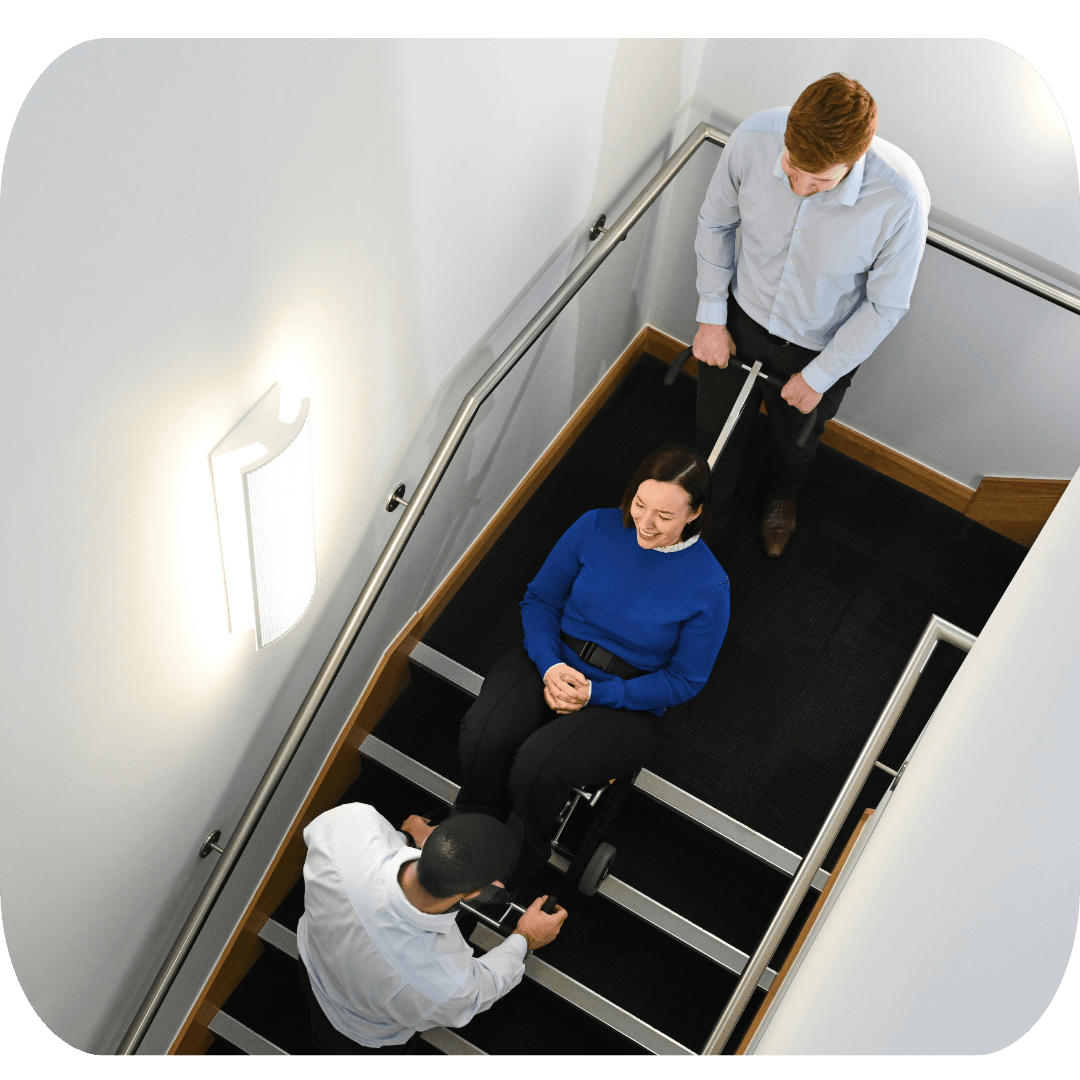
- Comprehensive range of evacuation chairs and solutions designed for both ascent and descent.
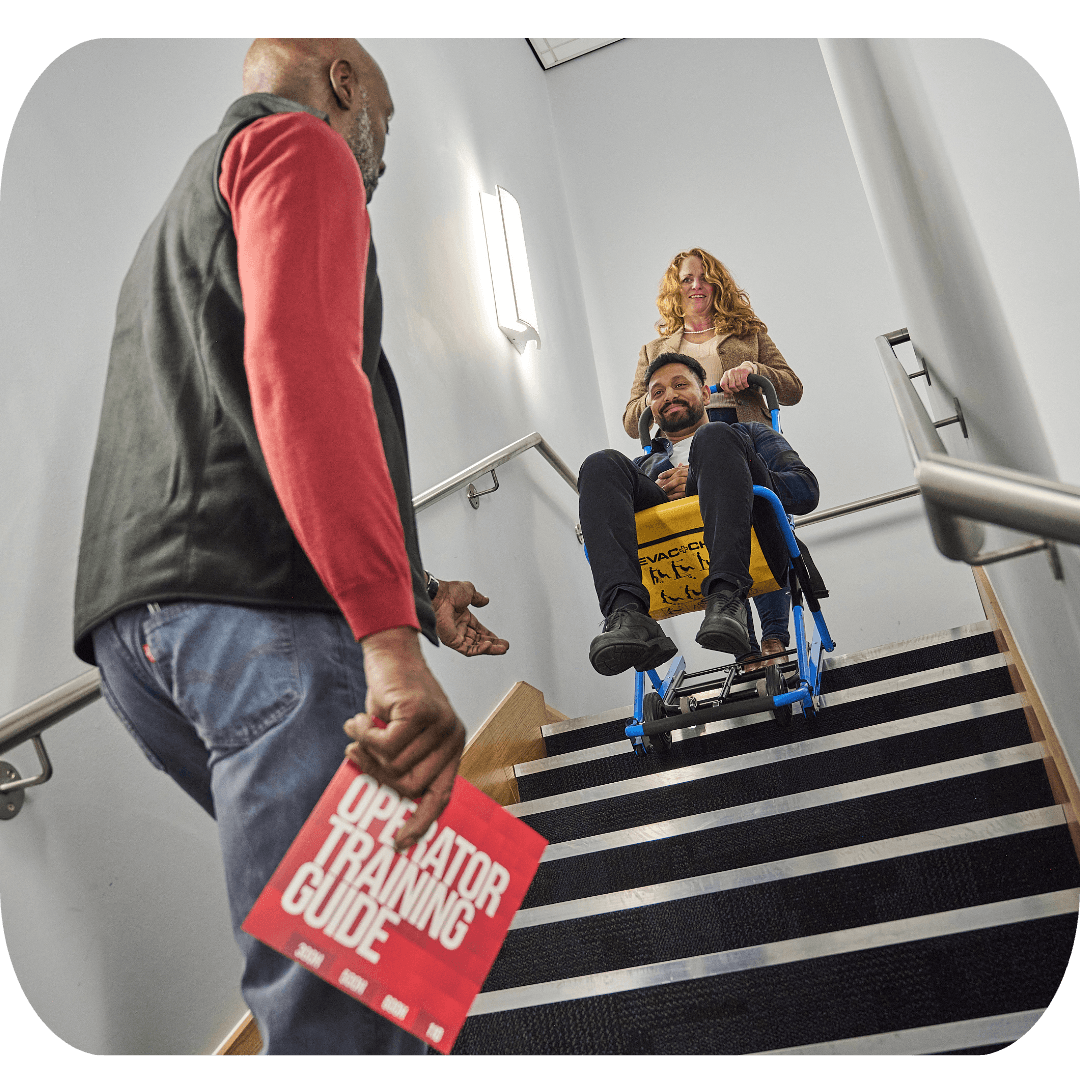
- Training courses to equip staff with the skills and confidence to operate equipment safely.
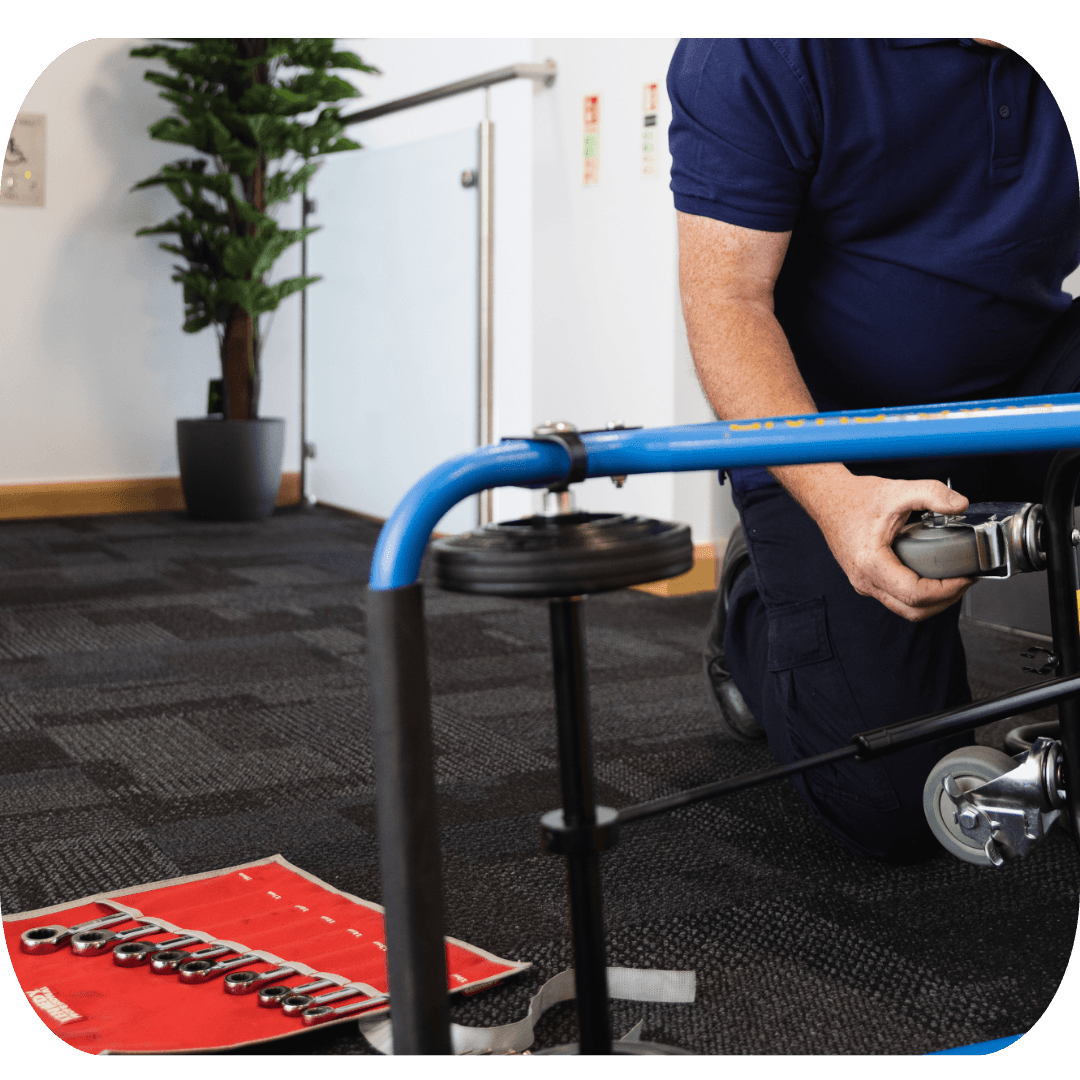
- Maintenance packages that guarantee ongoing compliance and readiness according to PUWER regulations.
- Supporting accessories to enhance efficiency and effectiveness.
About Evac+Chair
Evac+Chair is the original and world-leading manufacturer of emergency evacuation chairs. With over 40 years of experience, we are the trusted name across education, healthcare, hospitality, stadiums, transport, retail and public services – both in the UK and internationally.
Independently tested and proven to be the safest and fastest method of evacuation, we are committed to ensuring that every person, regardless of mobility, can evacuate safely during an emergency. Made in Britain and built to the highest quality standards, Evac+Chairs are strong yet lightweight, easy to operate and designed to deliver safe, dignified and efficient evacuations.
We support organisations in meeting legislative requirements, including Martyn’s Law, through:
- Evacuation solutions
- Training courses
- Maintenance plans
Trusted across the globe, Evac+Chair provides versatile solutions to suit a variety of staircases, building layouts and personnel needs. Our solutions deliver the performance, confidence and reliability you can count on when every second matters.
Prepare. Protect. Evacuate.
Martyn’s Law represents a significant shift in how organisations approach protective security, operational readiness and public safety.
Evac+Chair supports organisations with specialist evacuation solutions, preparedness training and compliance support to help strengthen emergency planning and improve inclusive evacuation capability during critical incidents.
Book a complimentary Evacuation Assessment Today!
Is your premises ready for Martyn’s Law? Don’t leave safety to chance - our complimentary Evacuation Assessment will ensure you’re fully prepared.
Book now!